
The Hidden Cost of Delaying Roof Repairs in North Carolina
- Serge Cano
- Mar 13
- 5 min read

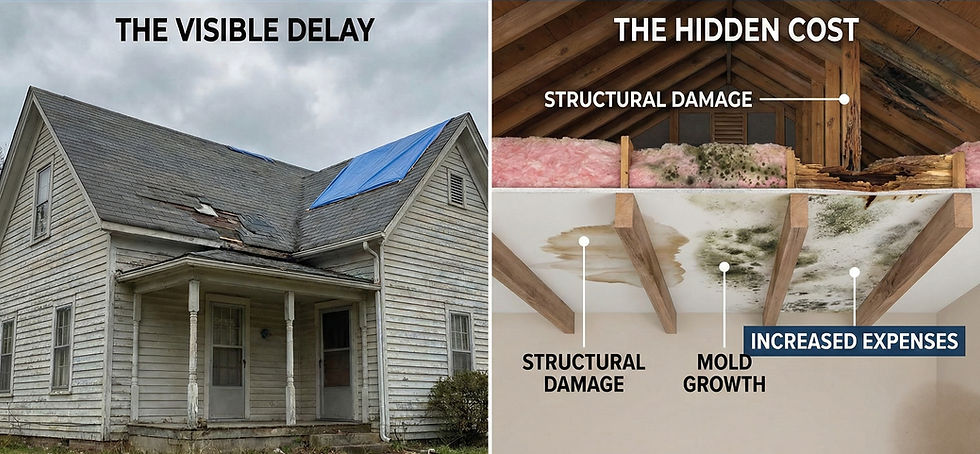
You've noticed a few missing shingles after the last storm. Maybe there's a small water stain on your ceiling that only shows up when it rains hard. It's tempting to add roof repairs to your "someday" list, especially when you're juggling other expenses.
But here's the truth: delaying roof repairs in North Carolina doesn't save you money. It costs you more, sometimes significantly more, and creates problems that go far beyond your roof itself.
Let's break down exactly what happens when you postpone necessary roof repairs and why acting quickly is always the smarter financial decision.
The Multiplication Effect: How Small Problems Become Big Ones
Roof damage doesn't stay contained. It spreads, multiplies, and creates cascading problems throughout your home.
One missing shingle becomes five: When one shingle goes missing, it exposes the shingles around it to more direct weather impact. Wind gets underneath adjacent shingles more easily, and soon you're looking at a whole section of missing shingles instead of just one.
A small leak becomes structural damage: That tiny drip you barely notice is steadily saturating your roof decking, insulation, and potentially your home's framing. Wood rot doesn't happen overnight, but it happens silently while you wait.
Minor repairs turn into full replacement: A $500 repair today might seem expensive, but it's far better than the $8,000-$15,000 full roof replacement you'll need if water damage compromises your entire roof deck.
The Real Costs of Waiting
1. Water Damage Repair ($2,000 - $10,000+)
Once water gets inside your home, the expenses multiply quickly:
Ceiling and wall repairs: Water-damaged drywall needs to be cut out and replaced. If the damage is extensive, you're looking at entire room renovations.
Insulation replacement: Wet insulation loses all effectiveness and often develops mold. It must be completely removed and replaced.
Flooring damage: Water that reaches your floors can ruin hardwood, carpet, or laminate, requiring complete floor replacement in affected rooms.
Paint and finishing work: After structural repairs, you'll need to repaint and refinish affected areas to match the rest of your home.
2. Mold Remediation ($500 - $6,000)
North Carolina's humidity creates perfect conditions for mold growth. Once water penetrates your roof, mold can develop within 24-48 hours.
Professional mold remediation is expensive and involves sealing off affected areas, removing contaminated materials, treating surfaces with antimicrobial solutions, and using specialized equipment to ensure complete removal. Some mold situations require temporary relocation during treatment.
Beyond the financial cost, mold poses serious health risks, especially for children, elderly family members, and anyone with respiratory conditions.
3. Increased Energy Bills ($20 - $100+ Monthly)
A damaged roof compromises your home's insulation and energy efficiency:
Wet insulation is worthless: Once insulation gets wet, it compresses and loses its insulating properties completely.
Air leaks increase: Gaps in your roof allow conditioned air to escape, making your HVAC system work harder year-round.
The costs never stop: Unlike one-time repairs, increased energy bills hit you month after month, year after year, until you finally address the root problem.
4. Compromised Home Value ($5,000 - $20,000+)
When it's time to sell your home, roof condition is one of the first things buyers and inspectors examine:
Failed inspections: Home inspectors will document every roof issue. Buyers will either demand repairs before closing or ask for significant price reductions.
Reduced buyer pool: Many buyers won't even consider homes needing major roof work, especially first-time buyers who can't afford immediate large expenses.
Lower appraisals: A damaged roof can lead to lower home appraisals, affecting your ability to sell at your desired price.
Disclosure requirements: If you know about roof problems and don't disclose them, you could face legal liability after the sale.
5. Emergency Repair Premiums (50% - 100% Markup)
When you delay repairs until there's an emergency, you lose all negotiating power:
Premium pricing: Emergency roof repairs cost significantly more than scheduled maintenance.
Limited contractor choice: You take whoever can come immediately, not necessarily who offers the best price or quality.
Temporary fixes cost extra: Emergency tarping and temporary repairs are additional expenses on top of the actual repair work.
Secondary damage control: You might need emergency water extraction, temporary housing, or storage for furniture while repairs happen.
Why NC Weather Makes Delays Especially Costly
North Carolina's weather patterns accelerate roof damage:
High humidity year-round: Our humid climate means any moisture that gets into your roof promotes rapid mold and rot development.
Frequent temperature swings: Even in winter, we can go from freezing to 60 degrees in a few days. This freeze-thaw cycle accelerates damage to compromised areas.
Heavy spring and summer storms: Our severe thunderstorms bring intense rainfall that exploits every weakness in your roof.
Hurricane potential: A roof that's already damaged is far more vulnerable to hurricane-force winds. What might have been minor damage becomes catastrophic during a major storm.
The Insurance Complication
Delaying repairs can also affect your insurance coverage:
Denied claims: If your insurance company determines that damage resulted from deferred maintenance rather than a covered event, they may deny your claim entirely.
Documentation matters: Having a history of regular maintenance and prompt repairs strengthens your position if you need to file a claim.
Policy cancellation risk: Some insurers may not renew policies on homes with known, unrepaired roof damage.
The Math That Matters
Let's look at a real-world example:
Scenario 1 - Act Now: You repair a small section of damaged shingles and flashing today for $800.
Scenario 2 - Wait Two Years: That same damage spreads, allowing water penetration. Now you're facing $2,500 in roof repairs, $3,000 in water damage and ceiling repair, $1,500 in mold remediation, plus two years of elevated energy bills at $50/month ($1,200 total). Total cost: $8,200.
Waiting cost you over $7,400 more than addressing the problem immediately.
Signs You Shouldn't Wait Any Longer
Some situations demand immediate action:
Any visible water stains inside your home
Missing or severely damaged shingles
Sagging areas on your roof
Daylight visible through your roof boards
Granules collecting in gutters
Recent storm damage
Your roof is over 20 years old
The Smart Financial Move
Think of roof repairs as an investment, not an expense. Every dollar you spend on timely maintenance saves you multiple dollars in avoided damage, preserved home value, and prevented emergency costs.
Most roofing companies offer free inspections and estimates. Getting your roof evaluated costs nothing, but the information you gain could save you thousands.
What to Do Right Now
If you've been putting off roof repairs, here's your action plan:
Schedule an inspection: Get a professional assessment of your roof's current condition and what repairs are needed.
Prioritize safety issues: Address any problems that could allow water penetration or cause further damage immediately.
Get multiple quotes: For larger repairs, get estimates from several reputable contractors.
Ask about financing: Many roofing companies offer financing options that make repairs more manageable.
Document everything: Keep records of all inspections and repairs for insurance and resale purposes.
The Bottom Line
Delaying roof repairs might postpone an expense, but it doesn't eliminate it. Instead, it guarantees that expense will be larger, more disruptive, and more stressful when you finally have to deal with it.
In North Carolina's climate, roof damage is progressive and accelerating. The question isn't whether you'll pay for repairs, but how much you'll pay and how much additional damage will occur before you do.
The most expensive roof repair is always the one you put off until tomorrow.


Comments